
The New Geopolitics of Talent - Why Governments Are Now Competing for Founders Like They Once Competed for Factories
Capital no longer dictates where talent goes; talent dictates where capital flows.
For most of the 20th century, countries competed for factories, and founders simply followed the money. Today, that logic has reversed. Governments are utilizing visas and tax regimes as modern industrial policy to actively import the "factories" of the 21st century, namely founders, researchers, and elite tech talent.
The data confirms this structural reallocation of human capital. According to BCG's 2025 Global Talent Mobility report, international movement among highly skilled professionals dropped by 8.5 percent year over year. But mobility isn't disappearing; it is concentrating.
As global talent borders shift, leading jurisdictions are running three fundamentally different playbooks:
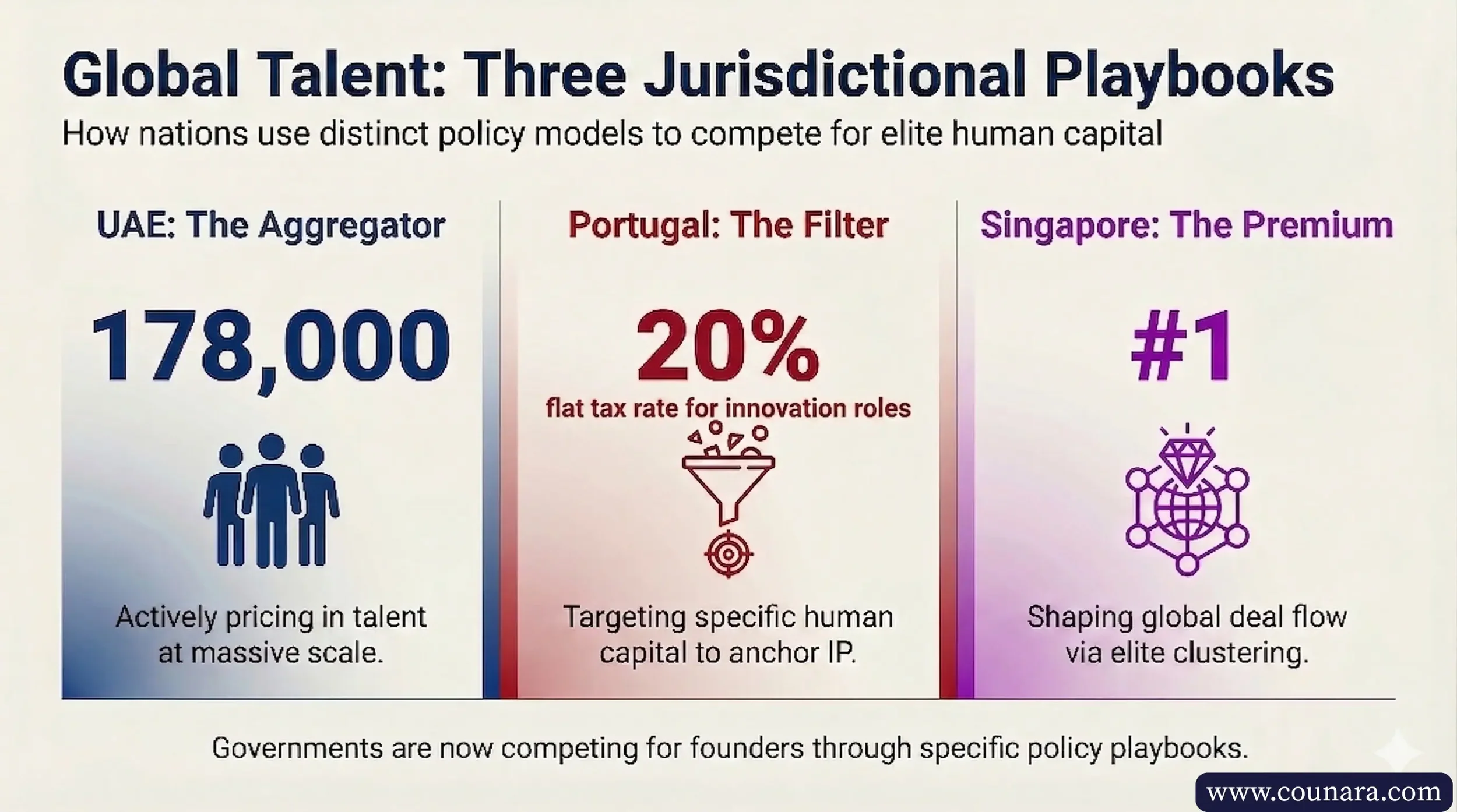
1. The Aggregator: Volume and Speed (The UAE) The UAE is optimizing for scale, rapidly shifting its Golden Visa from a wealth migration tool to a massive talent acquisition instrument. The UAE attracted approximately 178,000 highly skilled professionals in 2025, cementing its status as a top three global destination for STEM and AI talent. In 2023, the country issued roughly 158,000 Golden Visas (nearly double the previous year) with 60% going to working professionals rather than traditional investors. By adding new categories like esports, healthcare, and creative industries, the UAE is casting a wide net to build sudden, massive ecosystems.
2. The Filter: Targeted IP (Portugal) Portugal is optimizing for intellectual property. The country recently stepped away from its broad, open door Non Habitual Resident (NHR) program, closing it to new applicants in January 2024. It was replaced by the IFICI regime (NHR 2.0), which offers a flat 20% tax rate but acts as a precision filter. It is exclusively available to qualified professionals in scientific research, technology, education, and innovation roles. Portugal’s quiet statement is clear. It no longer wants all mobile capital; it wants the specific human capital that will anchor companies and generate long term IP.
3. The Premium Club: Elite Density (Singapore) Singapore is optimizing for elite clustering. In 2025, Singapore displaced Switzerland for the #1 spot on the Global Talent Competitiveness Index, a position Switzerland had held for a decade. Rather than competing on price, Singapore competes on rule of law, regulatory clarity, and a predictability premium. Their new ONE Pass (AI and Tech) track, launching in January 2027, uses strict financial gates. It targets professionals at tech companies valued at US$500 million or more, or startups with at least US$30 million in funding. They are deliberately curating a highly specific cluster of advanced tech talent to shape global deal flow for years to come.
The New Due Diligence for Investors
Most investment frameworks still treat founder location as a mere compliance question. For VCs, angel investors, and founders, this is a strategic error.
Jurisdiction is now a compounding operational asset or liability. When a government actively subsidizes a specific sector, a founder operating there gains structural tailwinds. Conversely, founders located in countries with tightening talent attraction policies (like Canada, which dropped to fourth place in talent share, or Germany, which saw a 9% decrease in inflows) carry a soft risk that will eventually hamper their ability to scale.
Factories followed infrastructure. Infrastructure followed capital. Now, capital follows people, specifically the people who build things that scale across borders. Investors who build that variable into their frameworks early will hold an edge that is hard to replicate. Those who don't will keep discovering it the hard way.