
Industrialized Cybercrime: How AI Is Rewiring the Logic of Fraud
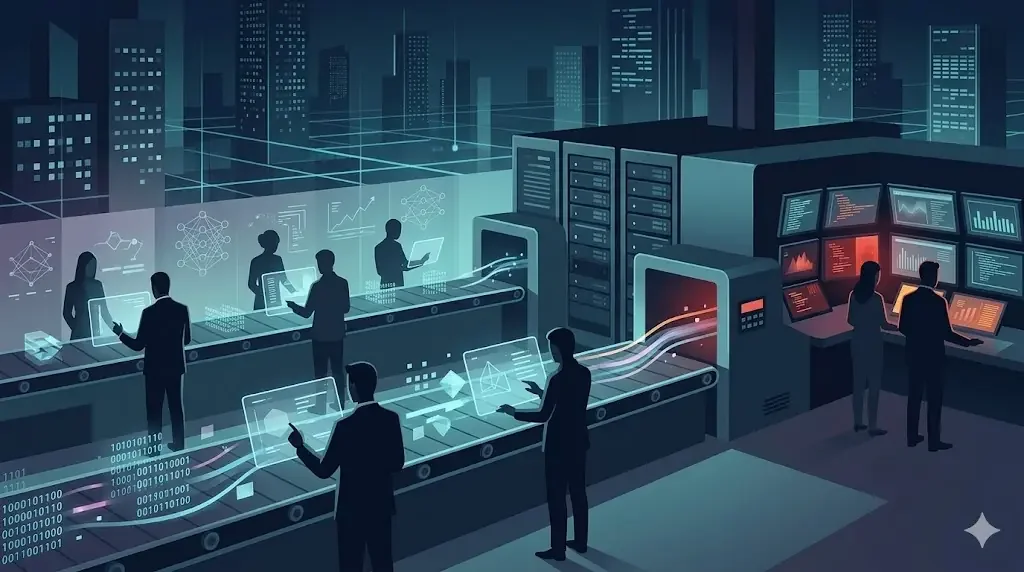
The real shift in 2026 is not only technical. It is operational.
In one recent incident, attackers posing as internal IT support escalated privileges to domain-admin level in under 40 minutes, relying on social engineering rather than malware alone. In other cases, deepfake voice and video have been used to imitate executives and pressure employees into authorizing large fraudulent transfers, exploiting hierarchy, urgency, and familiarity rather than technical weakness.
These are not anomalies. They are early signals of a larger shift in how cybercrime is organized.
Cybercrime in 2026 looks less like a collection of isolated actors and more like an industrial system. Threat groups increasingly operate through specialization, division of labor, supply-chain compromise, and automation, while AI accelerates reconnaissance, social engineering, and the scaling of attacks across multiple victims. The important story is not simply that attacks are increasing. It is that the economics and operating model of cybercrime have changed.
1. Identity and trust as infrastructure
Traditional perimeter thinking is weakening because attackers increasingly exploit trusted relationships rather than just “breaking in” from the outside. Group-IB’s 2026 reporting highlights supply-chain compromises and multi-victim incidents, where a single upstream breach in a software vendor or managed service provider cascades across many downstream organizations at once.
In that environment, identity stops being a narrow authentication issue and becomes structural infrastructure. Session tokens, help-desk workflows, SaaS integrations, internal messaging channels, and executive authority all become part of the attack surface. The old distinction between “technical security” and “human trust” starts to collapse, because trust itself is now routable.
2. The real asymmetry is speed
Recent threat reports describe a consistent pattern: attackers are compressing the time between initial access and follow-on actions, with handoffs between actors happening far faster than most organizations can investigate or respond. Whether a specific handoff takes seconds or minutes, the direction of travel is clear. Defenders are no longer racing only human operators. They are racing organized workflows supported by automation.
That shift turns time into a governance problem. If an attacker can move laterally, exfiltrate data, or prepare extortion paths before a human has even validated the first alert, resilience depends less on reacting well and more on designing systems that deliberately slow critical decisions down. In other words, the organization that controls its own tempo has an advantage over one that only adds more tools.
3. Governance for synthetic trust
Deepfake fraud and AI-assisted impersonation expose a deeper weakness in how organizations assign credibility. A familiar voice, a known face on video, a real project name, a correct invoice reference, or an internal-sounding message can no longer be treated as reliable proof of legitimacy.
This is not just a tooling issue. It is a design issue. If urgency, rank, or apparent familiarity can override verification, then the workflow itself is insecure. As deepfake voice and video become cheaper and more realistic, approvals, payment changes, and sensitive requests have to be redesigned around verification by process rather than trust by instinct. The organization that assumes “if I can hear or see you, I can trust you” is now structurally exposed.
What this means for daily work
For professionals and small teams, these macro shifts show up in very practical ways.
No urgency override. High-pressure requests, especially those tied to seniority or “last-minute” crises, should trigger more verification, not less. Treat urgency as a signal to slow the decision down.
Zero-trust for voice and video. A live call, voice note, or video meeting is no longer sufficient proof of identity for payments, credential resets, or changes in banking details. Identity needs a second channel.
Mandatory out-of-band checks. Any request involving money, access, or sensitive data should be confirmed through a pre-verified channel that is different from where the request appeared. Do not confirm a risky email inside the same email thread.
Delays and dual control as defenses. Standardized delays and two-person approval for exceptional actions are now security controls, not bureaucracy. They create a buffer against the speed of automated campaigns.
Assume attackers know the context. Project names, invoice references, vendor details, and public schedules should be treated as attacker-known data. Their presence in a message is not proof of legitimacy, only proof that someone is paying attention.
These habits are not about turning every interaction into a forensic exercise. They are about shifting from intuition-based trust to process-based trust in the few places where a single click can have disproportionate consequences.
Why this shift matters strategically
What makes AI-industrialized cybercrime strategically important is not the novelty of any single tool. It is the way those tools expose the weak points of modern operating environments: distributed teams, layered vendors, always-on communication, and a growing dependence on digital proxies for trust.
The better question for leaders is no longer whether they have the latest awareness training or another dashboard in the SOC. It is whether their decision paths, incentives, and guardrails were designed for a world in which trust can be simulated at scale, and where speed is set by automated systems rather than office hours.
I spend time reading threat reports, policy signals, and cross-industry analysis not because more information is valuable on its own, but because the real leverage is in the patterns underneath. If you are looking for someone who can translate dense material into usable mental models and strategy questions, I am open to project-based collaborations in this space